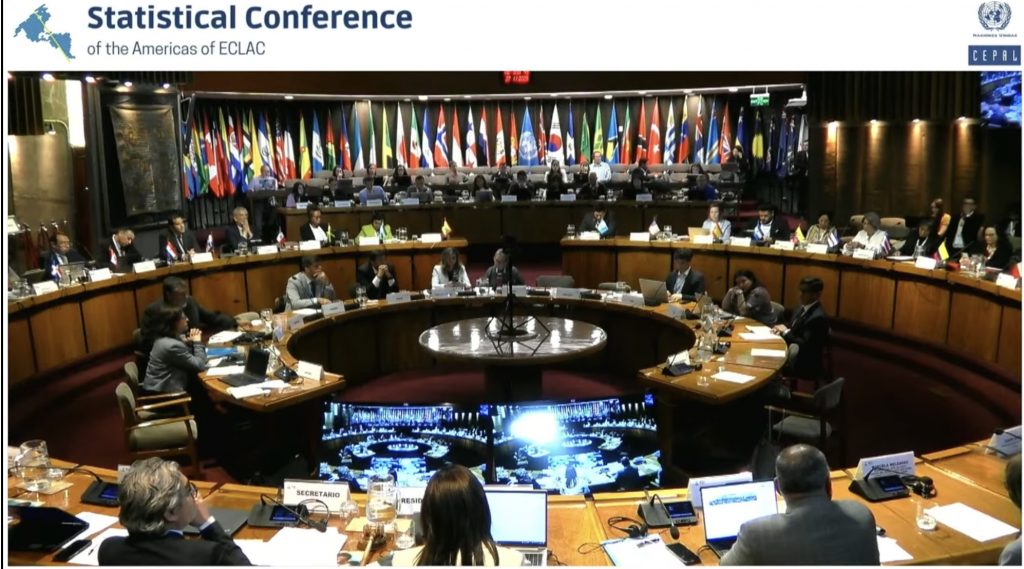
The Statistical Conference of the Americas of the Economic Commission for Latin America and the Caribbean (CEA-CEPAL) endorsed a Practical Guide for the Production of Harmonised Statistics on Forced Displacement and Migration in Latin America and the Caribbean as a new regional standard during its 13th meeting, convened in Santiago de Chile from 25-27 November 2025. The Guide promotes the generation of disaggregated and comparable data to make displaced and migrant populations visible and to strengthen national and regional responses with a human rights and social inclusion approach.
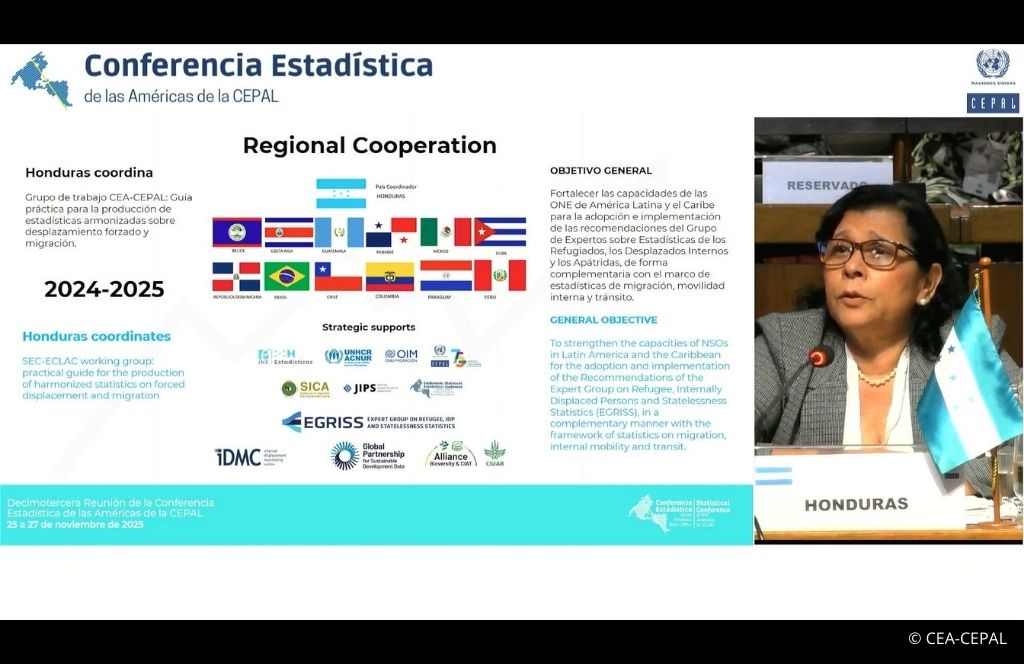
The Practical Guide is the result of a technical and collaborative process. Under the coordination from the National Institute for Statistics of Honduras, it was supported by a multi-stakeholder working group that comprised the national statistical offices (NSOs) from Brazil, Belice, Chile, Colombia, Costa Rica, Cuba , Guatemala, Mexico, Panama, Paraguay, Peru, and Dominican Republic. The group further involved regional and international actors, including CEPAL and the Central America Statistical Commission (CENTROESTAD) alongside EGRISS members JIPS, UNHCR, and IOM, as well as specialists in human mobility.
The group was created within the framework of the CEA-CEPAL Strategic Plan 2026-2035. The endeavour also built on previous processes of technical cooperation in displacement statistics carried out by EGRISS in Central America, led and coordinated by CENTROESTAD, UNHCR, IOM, and JIPS.
Migration, forced displacement, and asylum are increasingly relevant phenomena in Latin America and the Caribbean. In recent decades, the region has experienced multiple crises that have led to massive movements of people, both within countries and across borders. Despite advances in the measurement of international migration, important information gaps remain with respect to internal and cross-border forced displacement, as well as people in need of international protection. These gaps are most evident in contexts where the phenomenon is not formally recognised, which prevents the development of adequate regulatory frameworks and, consequently, the integration of these populations into official information systems.
In this context, there was a need for a regional tool to guide the production of statistics on forced displacement and asylum, harmonising approaches, concepts, and methodologies based on prevailing international frameworks. At the origin of the Guide is the strategic partnership consolidated in 2023 by the EGRISS regional Task Team, led by JIPS, UNHCR, CENTROESTAD, and IOM, with CEPAL to strengthen statistical production on IDPs, refugees, and stateless persons. A two-year working group was formalised in November 2023 during the 12th meeting of the Statistical Conference of the Americas (SCA) of ECLAC, for the 2024-2025 period.
Support from regional platforms and political will of a critical mass of countries with institutional capacity behind NSOs were essential to make this initiative possible. The potential use of administrative records to monitor solutions to forced displacement, to an extent unmatched in other regions, opened also interesting opportunities to explore with NSOs that have proven leadership in migration and displacement statistics globally.
The new regional standard, while refraining from imposing a single model, offers a common framework for regional cooperation and knowledge exchange. The guide is primarily intended for national statistical offices, sectoral ministries, inter-institutional coordination mechanisms, and other entities responsible for the production, management, and use of data on human mobility, based on criteria of relevance, comparability, quality, and a human rights approach.
The technical core of the guide (Chapter 4) presents guidelines for producing statistics on forced displacement and asylum from the main traditional sources: population censuses, national surveys, and administrative records, as well as their integration with migration statistics and SDG monitoring systems. Building on its comprehensive experience from supporting diverse countries across the globe, JIPS elaborated a mapping of indicators of durable solutions for forced migration and statelessness statistics (see Chapter 11), based on the Interagency Durable Solutions Indicator Library.
The Practical Guide is designed to be a dynamic tool, to be updated as migration and displacement phenomena evolve, and promotes international cooperation as a central axis. It builds on the three thematic Recommendations developed by EGRISS for statistics on refugees (IRRS), internally displaced persons (IRIS), and stateless persons (IROSS). The Guide also proposes broader coherence with the new Recommendations on International Migration and Temporary Mobility, endorsed in March 2025 during the annual meeting of the UN Statistical Division, and with the SDG framework.
The added value of the Practical Guide lies in offering a regional technical framework that articulates international recommendations with local practices, integrates diverse sources of information (surveys, censuses, administrative registers, and alternative data), and promotes a transversal gender and intersectional perspective.
The Guide includes a set of 8 recommendations aimed at strengthening national statistical systems, ensuring regional comparability, raising the visibility of frequently excluded populations, and improving the quality and use of data for decision-making. In summary:
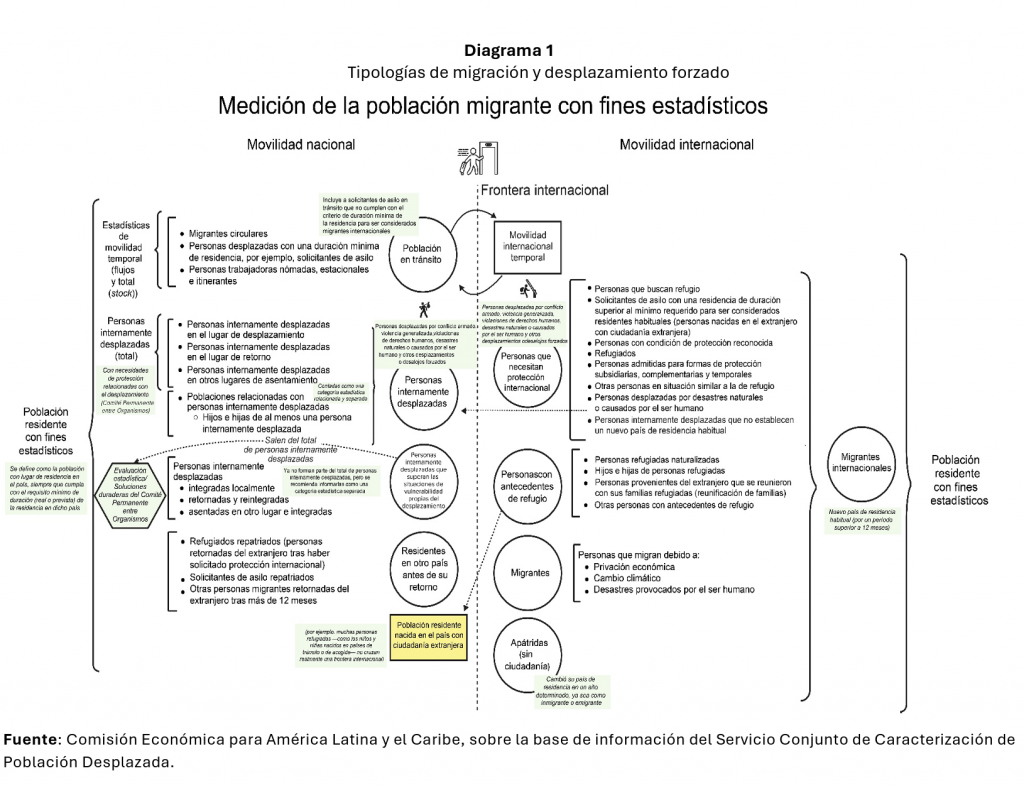
The guide proposes a regional typology for classifying different situations of human mobility, differentiating, for statistical purposes, between internal forced displacement, asylum, international migration, temporary mobility, and returns. Temporary mobility (migration in transit) refers to persons whose mobility does not imply a permanent change of habitual residence. This includes seasonal migrant workers, itinerant persons, nomads, as well as asylum seekers or displaced persons in transit who do not meet the minimum duration criterion to be considered international migrants. This group is often rendered invisible in conventional statistics, despite its relevance for the planning of services and the protection of rights.
The Guide highlights the need for a mechanism for unique identification, ideally through combinations of variables that allow each record to be uniquely individualised (a unique code for each person). Another set of fundamental variables corresponds to basic demographic data, particularly age and sex. It is also considered essential to record the previous usual place of residence and the current usual place of residence. The date of displacement constitutes another indispensable piece of information, as it allows knowing when the event occurred. Finally, it is recommended to include the reason for displacement, which allows identifying the main cause that forced the person or family group to leave their place of residence. Together, the different variables serve as a common basis for defining the universe of analysis and harmonising the categories used in the statistical instruments of the countries. It also highlights the importance of using operational definitions adapted to national contexts while maintaining a basic alignment with international frameworks.
The preparation of the guide was based on multiple preparatory activities: a comparative review of conceptual and normative frameworks on forced displacement, migration, asylum, and statelessness, elaborated by JIPS and CEPAL based in lessons learned from different country contexts; a regional diagnostic of statistical capacities and information gaps, led by UNHCR; the systematisation of good practices in data production in different countries of the region; and a process of technical consultations and validations with institutional actors, civil society organisations, and international agencies.
The Guide is aligned with the international commitments assumed by countries in the areas of human rights, migration, refuge, international protection, sustainable development, and the production of statistics with a gender and intersectional perspective.
NSOs already started disseminating and operationalising the Practical Guide, notably with the identification of migrants, refugees and IDPs in statistical sources in Honduras, Guatemala, Peru, Mexico and Colombia. Going forward, the harmonisation of standards proposed in the Guide will entail further regional cooperation between NSOs and peer exchange on lessons and best practices.
—
JIPS’ support in developing this Practical Guide since 2024 has been made possible through the generous co-funding and multi-donor partnership with the European Commission’s Directorate-General for European Civil Protection and Humanitarian Aid Operations (ECHO), the Danish International Development Agency (DANIDA), and USAID’s Bureau for Humanitarian Assistance (BHA). The contents of the guidance are the responsibility of the actors involved and do not necessarily reflect the views of ECHO, DANIDA, or BHA.