This Guide provides technical guidelines that strengthen the capacity of Latin American and Caribbean countries to generate statistical information on forced displacement and asylum, based on criteria of relevance, comparability, quality, and a human rights approach. It does not seek to impose a single model, but rather to offer flexible guidelines that can be adapted to different national contexts, taking into account the progress, challenges and specific needs of each country.
Its added value lies in offering a regional technical framework that articulates international recommendations with local practices, integrates various sources of information (surveys, censuses, administrative records and alternative data) and promotes a cross-cutting approach to gender and intersectionality. It also seeks to contribute to the integration of these statistics into migration monitoring systems and the Sustainable Development Goals (SDGs).
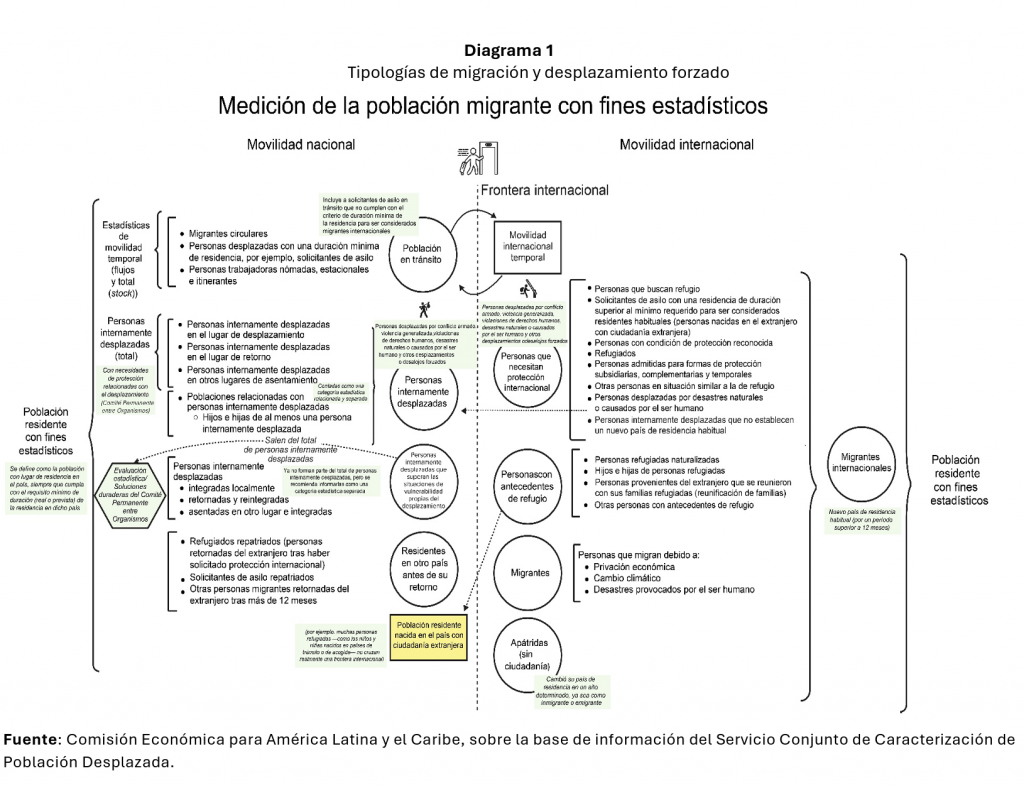
The Guide is organised into seven chapters. Chapter 4 constitutes the technical core of the Guide and offers concrete guidance for each type of statistical operation. It presents guidelines for the production of statistics on forced displacement and asylum from the main traditional sources: population censuses, national surveys, and administrative records, as well as their integration with migration statistics and SDG monitoring systems.
The Guide is primarily intended for national statistical offices, sectoral ministries, inter-institutional coordination mechanisms, and other entities responsible for the production, management, and use of data on human mobility. It was developed through a technical and collaborative process that was coordinated by the National Institute for Statistics of Honduras and involved the national statistical offices (NSOs) from Brazil, Belice, Chile, Colombia, Costa Rica, Cuba , Guatemala, Mexico, Panama, Paraguay, Peru, and Dominican Republic, alongside regional and international actors (incl. CEPAL, the Central America Statistical Commission [CENTROESTAD], EGRISS members with JIPS, UNHCR, and IOM, and specialists in human mobility).
—
JIPS’ support in developing this Practical Guide since 2024 has been made possible through the generous co-funding and multi-donor partnership with the European Commission’s Directorate-General for European Civil Protection and Humanitarian Aid Operations (ECHO), the Danish International Development Agency (DANIDA), and USAID’s Bureau for Humanitarian Assistance (BHA). The contents of the guidance are the responsibility of the actors involved and do not necessarily reflect the views of ECHO, DANIDA, or BHA.